Postcoital antifertility agents

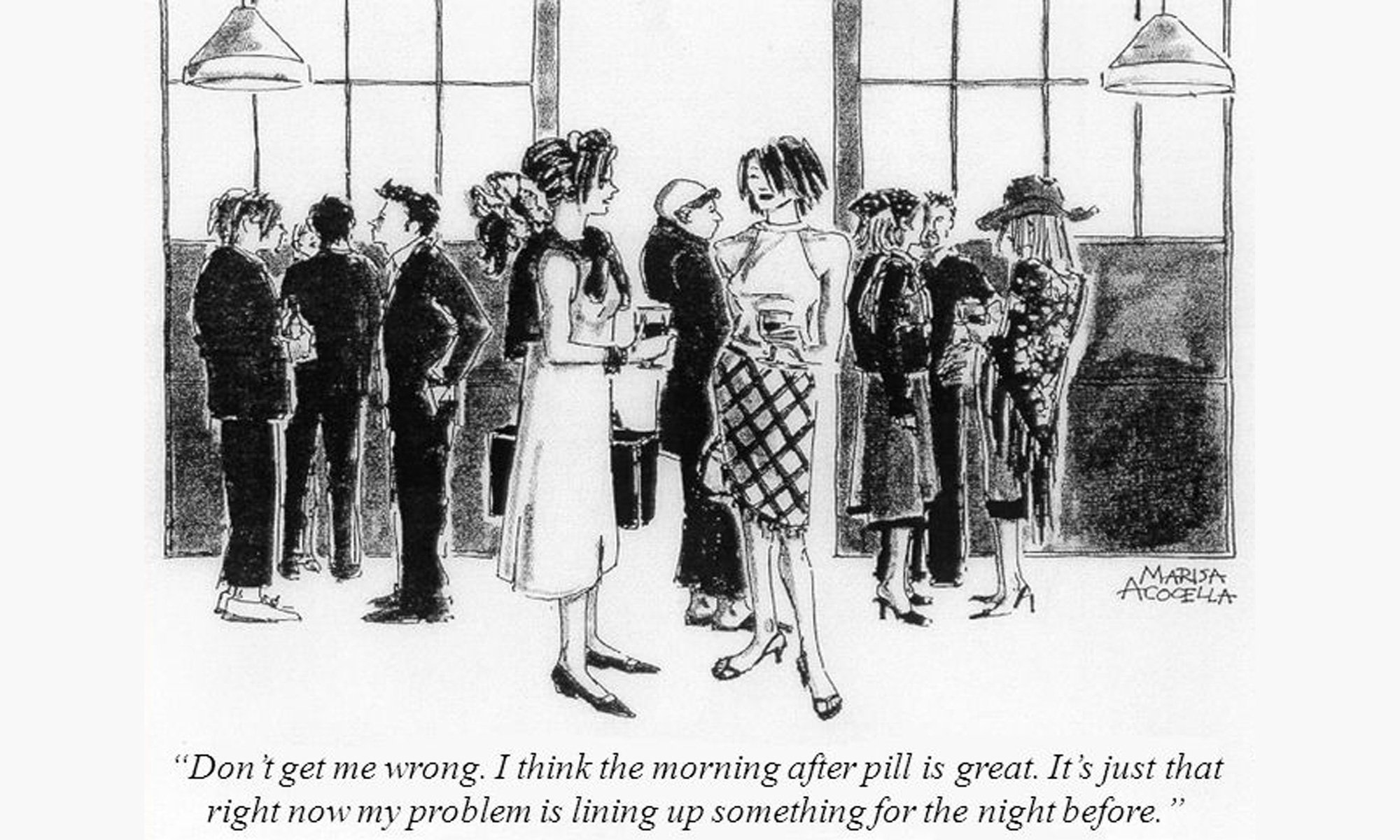
Diethylstilbestrol as a “morning after” pill

1972 Study Abstract

Investigators have studied a variety of agents to determine their usefulness in postcoital antifertility.

To determine the mechanism of action of postcoitally administered estrogen, 2 groups of regularly ovulating volunteers were given 25mg of diethylstilbestrol for 5 days, beginning on Day 1 of basal temperature rise.

Blood samples were taken from 1 group every 1-3 days to measure the levels of plasma progesterone. The other group had endometrial biopsies on the fifth day after the basal temperature rise about the time implantantion would obcur.

Preliminary results showed lowered levels of plasma progesterone, and biopsy on cycle Day 20 showed endometrium resembling that expected on Day 16. Decreasing levels of circulating progesterone prevent the usual rise in endometrial carwonic anhydrase, inhibiting blastocyst implantation.

Reports of adenocarcinoma in female offspring of mothers who have taken diethylstilbestrol in early pregnancy lead authors to suggest use of ethinyl estradiol 2 to 3mg daily starting within 48 hours of coitus when postcoital contraception is desired. However, side effects of nausea and vomiting restrict its use to isolated instances and it should not be used routinely.

Sources

  • Postcoital antifertility agents, Southern Medical Journal, popline, 1972 Nov.
  • Image credit Curtis Potvin.
DES DIETHYLSTILBESTROL RESOURCES

How Soon Will We Have the “Ideal” Contraceptive ?

” If we wait for vastly new advanced techniques, instead of making better use of what we now have, it may be too late for the ideal method to help solve our population problems ! “

Abstract

… “The closest to a morning after pill has been the three-day use of large doses of diethylstilbestrol (75 mg) after exposure to pregnancy.

This approach has been utilized by gynecologists for many years, although its effectiveness has not been conclusively demonstrated.

It is by no means a new method, despite current magazine articles to the contrary.” …

Sources

DES DIETHYLSTILBESTROL RESOURCES

Post-coital contraception, first-aid use, 1972

…”Though the area of post-coital contraception seems to offer one of the most likely advances in fertility control, the morning-after pill is probably best restricted to first-aid use.”…

Abstracts

…”In 1938 two oestrogenic compounds were found to be active when taken by mouth-diethylstilbcestrol 11 and ethinyloestradiol; both prevented implantation in rabbits.’…

…”Until lately, oestrogens were used post-coitally in women only as a first-aid measure: DODDS found them useful after rape, but was uncertain of their reliability; …” …

…” KucHERA, in 1971, reported her experience using 50 mg. daily of diethylstilboestrol for 5 days in 1000 women of childbearing age exposed to unprotected intercourse. … … No pregnancies were recorded after this treatment.”…

…” HASPELS, this year,described post-coital treatment with both ethinyloestradiol and diethylstilboestrol in 2000 women. … …. There were no pregnancies after 5 mg of ethinyloestradiol for 5 days or 50 mg of stilboestrol for 6 days. ” …

Sources

DES DIETHYLSTILBESTROL RESOURCES

DES use as a postcoital contraceptive agent, 1970

Endometrial Carbonic Anhydrase After Diethylstilbestrol as a Postcoital Antifertility Agent

1970 Study Abstract

Others have shown that the oral administration of diethylstilbestrol 25 mg daily for 5 days is an effective postcoital antifertility method.

This dose of the estrogen was started in 4 volunteers on the day basal temperature rose.

Endometrial carbonic anhydrase, 5 days after the temperature rise, was lowered to an average of 9.8 enzyme units (EU)/g as compared to the average control value of 21.2 EU/g.

This decreased carbonic anhydrase activity may represent a barrier to implantation, although other antifertility mechanisms may also be activated by diethylstilbestrol.

Sources

  • Endometrial Carbonic Anhydrase After Diethylstilbestrol as a Postcoital Antifertility Agent, Obstetrics & Gynecology, greenjournal, September 1970.
  • Featured image credit Nicholas Gercken.
DES DIETHYLSTILBESTROL RESOURCES

Post-coital DES in large doses

DES use as a postcoital contraceptive agent is discussed

1972 Study Abstract

To study the contraceptive effective in human beings, large doses of estrogen were administered to 2000 women between 14 and 52 years of age.

In 1418 cases (71%) ethinyloestradiol (EO) was used, in 524 cases (26%) diethylstilbestrol (DS), and in 58 cases (3%) the estrogen administered was not recorded.

In 47.5% the unprotected coitus occurred between 12 and 16 days before the next expected menstruation, in 60.9% it occurred between 10 and 17 days, and in 9.6% (193 cases) the day of the cycle was not mentioned.

There were 14 pregnancies among the 2000 women. In only 3 cases did the pregnancy occur after 3 mg doses of EO or 30 mg DS started within 36 hours. No pregnancies occurred after 5 mg EO or 50 mg DS. In 3 cases the pregnancy could have been the result of a later unprotected coitus. In another 3 cases medication was started after more than 48 hours.

In cases of vomiting occurring within 1 hour after ingestion of a tablet, another tablet was given 30 minutes after an anti-emetic. If all tablets were vomited estradiol benzoate, 30 mg per day for 5 days, was injected. Other side effects were tender breasts, menorrhagia, headache, dizziness, abdominal pain, and amenorrhea. Changes in their cycle were reported by 662 women. Most stabalized after 1 cycle. Side effects prohibit this method for routine contraception but it could be valuable in special cases.

There is as yet no statistical proof of its degree of effectiveness. The method of action of these drugs is not certainly known.

Sources

DES DIETHYLSTILBESTROL RESOURCES

The “morning-after pill”

The use of diethylstilbestrol (DES) as a postcoital contraceptive agent is discussed

1971 Study Abstract

A course of post-coital estrogens, in adequate dosage, is a highly effective and safe (though misnamed) form of post-coital contraception that deserves to be more widely known and prescribed. Both unwanted pregnancies and the demand for abortion could be reduced by its widespread use in emergency situations.

Several natural and synthetic estrogens have been used in various dosages; a popular regimen is 5 milligrams of stilbestrol, 5 times per day for 5 days, preferably accompanied by an anti-emetic, since nausea and occasional vomiting may occur.

Some authorities advise starting the course of estrogens within 48 hours of unprotected intercourse and others set a reliable outside limit of 72 hours, turning a Friday night indiscretion into a Monday morning routine appointment rather than a weekend emergency.

For a series of 30 cases started on the above dosage within 72 hours of coitus without contraception or with condom failure, I am able to report no pregnancies. These patients proved particularly responsive to counselling, almost all keeping subsequent appointments for a more satisfactory method of birth control.

Similar success was reported verbally at the recent American College Health Association conference1 by a gynecologist from Yale.

An interim report from the University of Utrecht indicated no failures in 72 women using post-coital estrogens, and a comprehensive review of the literature on the subject, with an analysis of 1000 cases, is to be presented by the same author at the forthcoming Fertility-Sterility Conference in Tokyo in October.

Professor Haspels’ excellent paper should do much to clear up the confusion that exists in many minds between this highly reliable method of post-coital contraception and the virtually useless attempts that are sometimes made to terminate a pregnancy by administering estrogens after a missed menstrual period.

This subject is, of course, unrelated to the use of prostaglandins, which is an entirely different story.

Sources

  • The “morning-after pill”, Canadian Medical Association journal, NCBI PubMed PMC1931140, 1971 Aug 7.
  • Image credit mymorningafter.
DES DIETHYLSTILBESTROL RESOURCES

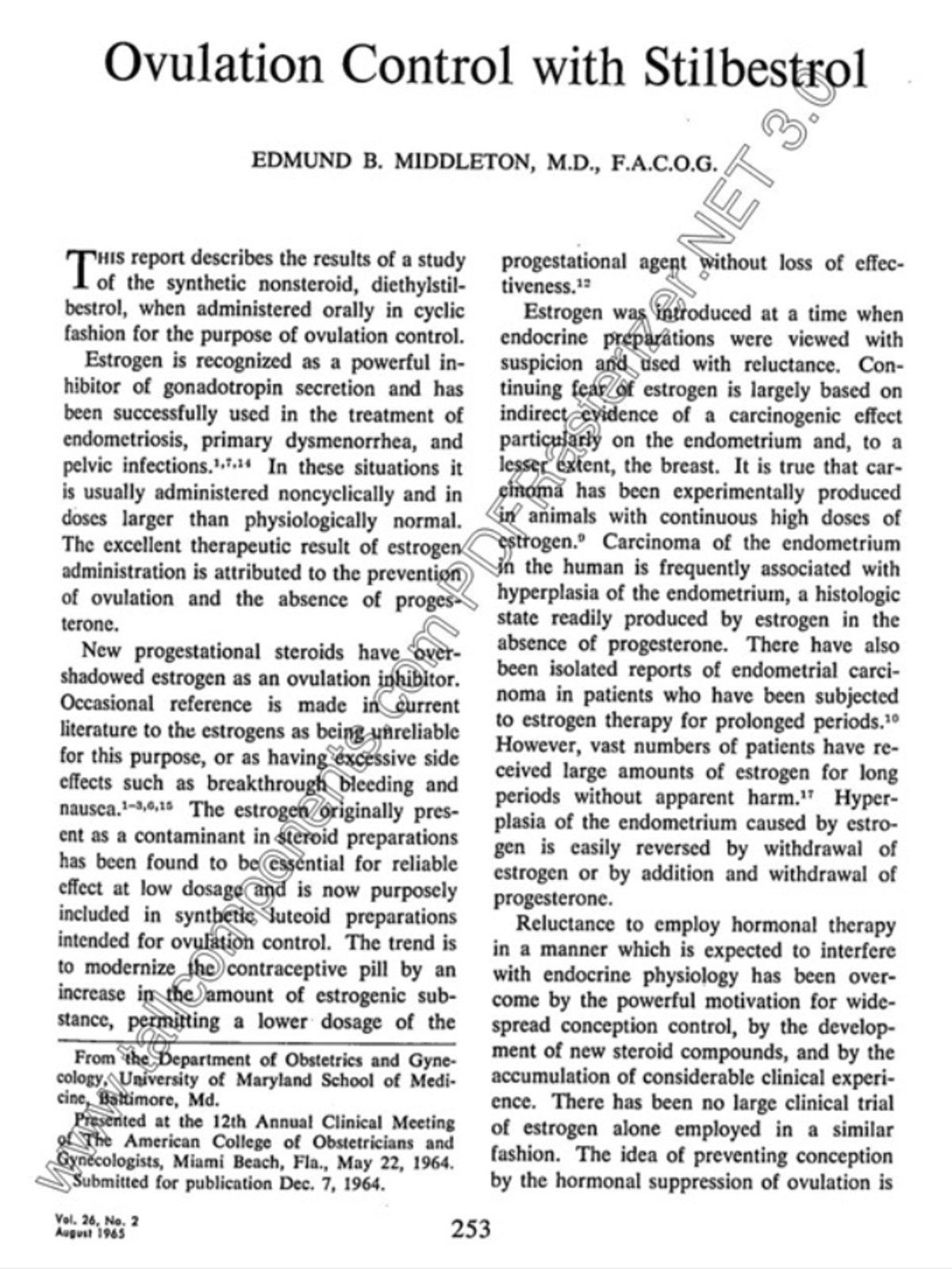
Ovulation Control with Stilbestrol

Obstetrics & Gynecology : August 1965 – Volume 26 – Issue 2 – ppg 253-257

Abstract

Sources

  • Ovulation Control with Stilbestrol, Obstetrics & Gynecology, Volume 26 – Issue 2 ppg 253-257, August 1965.
  • Featured image black out ace.
DES DIETHYLSTILBESTROL RESOURCES

Postcoital contraception : present and future options

DES still used for emergency contraception in 1995

Abstract

PURPOSE
This article reviews information on currently available postcoital contraceptives, and discusses recent advances in postcoital contraception, mostly notably RU 486.

METHODS
Postcoital contraceptives, or “morning after pills,” are currently available in the form of high dose estrogens, oral contraceptives, danazol and intrauterine devices. These methods are plagued by high incidences of side effects and less than optimal success rates.

RESULTS
Currently, their primary use in the adolescent age group is for victims of sexual assault, but they may also be used as back-up for consensual unprotected intercourse. RU 486, best known as a first trimester abortifacient, has a number of potential uses, including that of a postcoital contraceptive. Two recently published studies from the UK showed RU 486 to have a very low pregnancy rate and fewer side effects when compared with current methods. RU 486 may someday replace high doses of oral contraceptives as the method of choice for postcoital contraception.

PIP
Postcoital contraceptives are available for adolescent use in the US. They include combination oral contraceptives (OCs), high dose estrogens, danazol, and IUDs. Mifepristone (RU-486) is currently not available in the US but is used in France, the UK, and Sweden. Postcoital contraception is especially important for adolescents who have a very high pregnancy rate due to poor contraceptive use. Administration of 2-5 mg ethinyl estradiol (EE) for 5 days beginning within 72 hours of unprotected intercourse yields pregnancy rates ranging from 0-0.92%. EE-related side effects include nausea, vomiting, sore breasts, and irregular menstrual bleeding. DES should not be used, since it is associated with reproductive tract anomalies and vaginal cancers in exposed offspring. Conjugated estrogens have not been used in adolescents for postcoital contraception. The Yuzpe regimen consists of 2 tablets of a combined OC with 200 mg EE and 2 mg dl-norgestrel administered within 72 hours of unprotected intercourse followed by the same dose 12 hours later. Common side effects are nausea and vomiting. Its pregnancy rate is 1.8%. Levonorgestrel-containing OCs can also be used. Administration of 800-1200 mg danazol up to 120 hours after unprotected intercourse protects against pregnancy in about 98% of cases. Copper IUDs have a high efficacy rate when used as postcoital contraception (99.9%), but public opinion, medicolegal considerations, financial costs, and potential for infection impede IUD as a postcoital contraceptive in the US. RU-486 is best known as an abortifacient. It is also a potential postcoital contraceptive. Two UK studies find that RU-486 used as a postcoital contraceptive has a very low pregnancy rate and fewer side effects than the Yuzpe regimen and danazol. It is much more costly than currently used postcoital contraceptives (600 mg of RU-486 cost US$ 68, while Ovral costs US$ 0.48-2.24). Nevertheless, RU-486 may replace the higher doses of OCs as a postcoital contraceptive method.

Sources

  • Postcoital contraception: present and future options, The Journal of adolescent health : official publication of the Society for Adolescent Medicine, NCBI PubMed PMID: 7742340, 1995 Jan.
DES DIETHYLSTILBESTROL RESOURCES

Emergency contraception : 1994 review

Diethylstilbestrol used as a “morning after” contraceptive

Abstract

In the Netherlands, many women use a postcoital method of contraception in “emergency” situations.

Postcoital contraception started in the 1960’s with the administration of large doses of estrogens: 50 mg diethylstilbestrol for 5 days or 5 mg ethinylestradiol for 5 days.

In the eighties, a double-blind study compared the original hormonal therapy of 5 mg ethinylestradiol for 5 days with a combination pill containing just 0.1 mg in combination with 1 mg d1-norgestrel, of which two doses are give, the second 12 hours after the first. This method was as effective in preventing pregnancy as the original treatment with high estrogen dosage. Moreover, it resulted in women suffering less nausea and vomiting. One study from Hong Kong indicated that levonorgestrel without ethinylestradiol was as effective as the combination. Postcoital use of an intrauterine device to prevent pregnancy can be used as an alternative to the hormonal method. A recent development is the use of an antiprogestagen pill: 600 mg Mifepristone on day 27 of the cycle; side effects are minimal and the success rate is high. Mifepristone should be registered and made available in all countries for this indication.

PIP

Many women in the Netherlands depend on a postcoital contraceptive (PCC) method in situations of unprotected intercourse. The incidence rate for abortions and for adolescent pregnancies in the Netherlands is the lowest worldwide. Dutch society matter-of-factly accepts adolescent sexuality and provides formal and informal sex education and readily accessible contraceptive services. Emergency contraception should be administered within 72 hours after unprotected intercourse (e.g., rape or incest) or mechanical contraceptive failure. Administration of 5 mg ethinyl estradiol (EE) for 5 days as a PCC first occurred in the Netherlands in 1964, and PCC usage peaked at 55,000 in 1975. Side effects of EE include, in order of frequency, nausea, vomiting, tender breasts, and menorrhagia. Possible modes of action for EE are more rapid transport of fertilized ova through the oviduct and slowed maturation of the endometrium, resulting in suppressed implantation. The Yuzpe PCC method involves 4 tablets of a combined oral contraceptive (each tablet with 50 mcg EE + 250 mcg levonorgestrel) administered within 72 hours followed by 2 tablets 12 hours later. Side effects are similar to those of EE alone, as is the effectiveness rate. A dose of 0.75 mg levonorgestrel alone is as effective at preventing pregnancy as the Yuzpe regimen. Side effects are considerably less common with the levonorgestrel regimen than the Yuzpe regimen. For women who present more than 72 hours after and less than 7 days after unprotected intercourse or for those with contraindications to estrogen, a copper-releasing IUD can serve as a PCC. A postcoital IUD can cause serious complications for women with a sexually transmitted disease, however. Taking RU-486 during the luteal phase of the menstrual cycle greatly drops plasma levels of progesterone and estradiol. Postovulatory administration of an antiprogestogen is the best PCC method because of minimal side effects and a high success rate.

Sources

DES DIETHYLSTILBESTROL RESOURCES

Postcoital contraception underrecognized and underutilized

Diethylstilbestrol as a “morning after” contraceptive

1992 Study Abstract

Postcoital contraception can play an important role in the prevention of unwanted adolescent pregnancy in the US.

Diethylstilbestrol (DES), 25 mg twice daily for 5 days within 24 to a maximum of 72 hours after unprotected sexual intercourse, received US Food and Drug Administration (FDA) approval for pregnancy prevention in 1973.

In 1978, however, the manufacturer, Eli Lilly, included in its packaging instructions that DES should not be used for postcoital contraception given the development of clear-cell adenocarcinoma of the vagina or cervix in the daughters of women who took DES to prevent spontaneous abortion.

The FDA had not withdrawn its approval of DES for this purpose. Other drugs that have been effectively used for postcoital contraception include 0.5 mg of norgestrel and 0.05 mg of ethinyl estradiol (2 tablets within 72 hours of unprotected intercourse and another 2 tablets 12 hours later) and conjugated estrogens.

This approach to pregnancy prevention sidesteps many of the medical and moral complexities associated with use of the abortifacient RU-486. In fact, the Catholic bishops of Great Britain have approved the use of postcoital contraception in women who are victims of sexual assault.

Sources

  • Postcoital contraception underrecognized and underutilized, Female Patient, NCBI PubMed PMID: 12287765, 1992 Jun.
  • Featured image bunchfamily.
DES DIETHYLSTILBESTROL RESOURCES