Case-control study of testicular cancer, 1988

Connecticut tumour registry data, International journal of epidemiology

1988 Study Abstract

This case-control study was designed to determine whether males who were exposed to diethylstilboestrol (DES) in utero are at increased risk of testicular cancer.

Questionnaires were completed for 79 residents of Connecticut, who were diagnosed with primary cancer of the testes between 1945 and approximately six months into 1980.

An equal number of matched controls drawn from birth certificate records available from the Connecticut State Department of Health Services also submitted questionnaires.

Information included data on past medical conditions of subjects and obstetrical history of mothers.

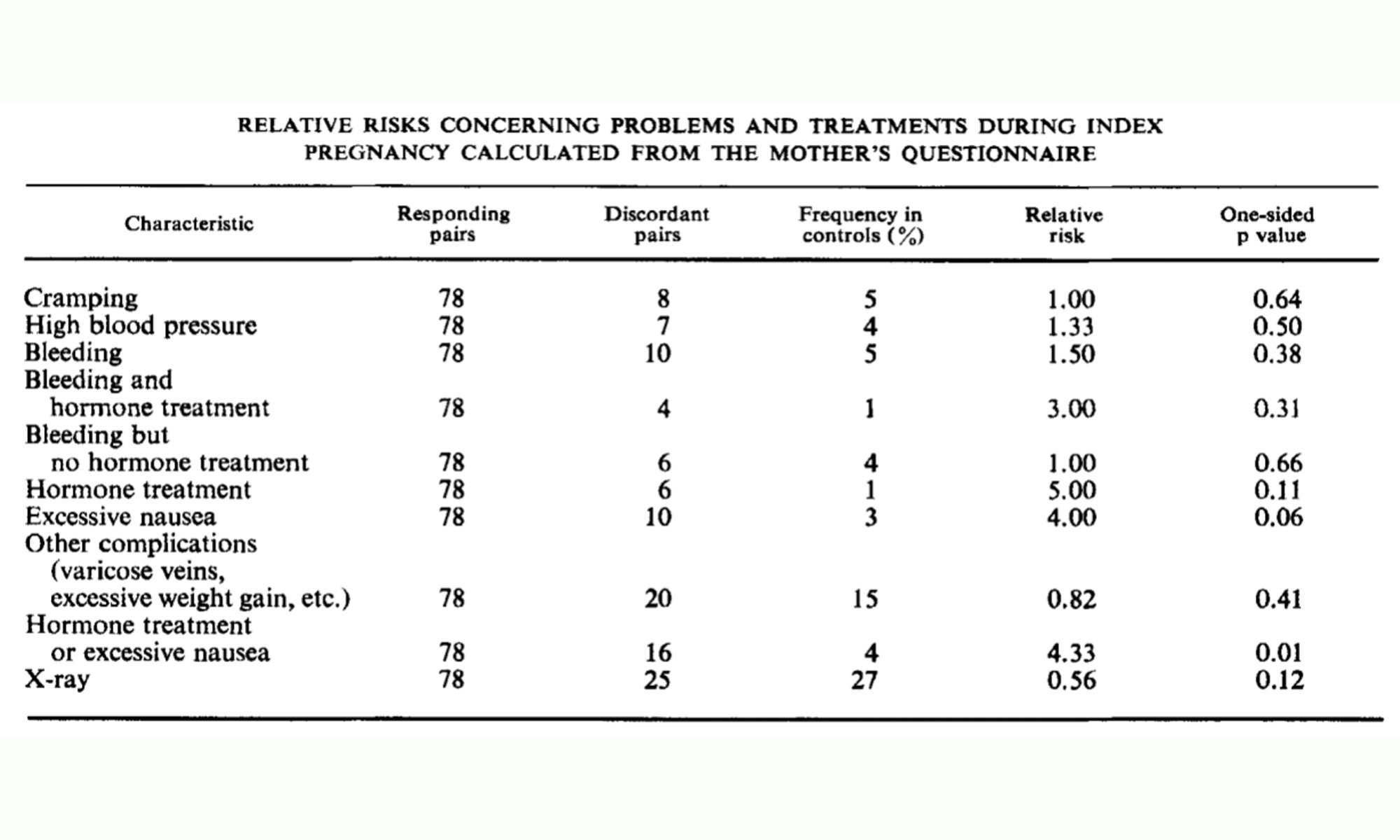
The major finding of this study was a statistically significant elevated risk for premature birth for the testicular cancer cases.

The study failed to show that DES increased the risk for testicular cancer.

However, in view of the findings from previous human and animal studies of such abnormalities as undescended and hypoplastic testes as well as the consideration that only the earliest exposed birth cohort has reached the age of substantial cancer risk, it would seem prudent for any male who has been prenatally exposed to DES to seek medical follow-up.

Remark

Since DES stopped being prescribed in 1971, and since testicular cancer takes time to develop, we believe it’s reasonable to think the study’s cases (diagnosed between 1945 and 1980) do not match DES Sons exact profiles / conditions .

References

  • A case-control study of testicular cancer using Connecticut tumour registry data, International journal of epidemiology, NCBI PubMed, PMID: 3225080, 1988 Dec.
  • Featured image credit patioyarddesign.
DES DIETHYLSTILBESTROL RESOURCES

Prenatal and perinatal risk factors for testicular cancer

Cancer research, Clinical and Epidemiological Investigations, 1986

Abstract

In an attempt to determine the risk factors responsible for the dramatic increases in testicular cancer incidence in young adults, mothers of testicular cancer cases and controls were questioned about in utero exposures, pregnancy-related conditions, and perinatal factors during their pregnancies with the 202 cases and the 206 controls.

  • The strongest risk factor was low birth weight with a greater than 12-fold risk (confidence interval = 2.8 to 78.1) for subjects weighing 5 lb or less at birth compared to those who weighed over 5 lb.
  • A statistically significant 2-fold increase in risk was associated with unusual bleeding or spotting during pregnancy, regardless of whether medication was taken for this condition.
  • Other exposures during pregnancy associated with a statistically significant increase in risk were:
    • use of “sedatives”;
    • alcohol consumption;
    • and exposure to X-rays.
  • No excess risk was associated with the use of hormones during pregnancy.

The findings for birth weight and abnormal uterine bleeding suggest that significant compromise of the normal maternal-fetal environment may be associated with subsequent increase in risk of testicular cancer. However, this increase in risk is not great enough to explain the dramatic increases in testicular cancer that have occurred in young adults.

References

  • Prenatal and perinatal risk factors for testicular cancer, Cancer research, NCBI PubMed, PMID: 3731127, 1986 Sep.
  • Featured image credit patioyarddesign.
DES DIETHYLSTILBESTROL RESOURCES

Hormonal risk factors in testicular cancer

A case-control study, American journal of epidemiology, 1986

Abstract

The authors interviewed 273 northern California testicular cancer cases aged 40 and under diagnosed between 1976 and 1981, their mothers, and matched peer controls and their mothers on prenatal hormone exposure and other variables.

Included was a population-based substudy (1979-1981) of all interviewable cases reported to the San Francisco Bay Area Surveillance, Epidemiology, and End Results registry.

They found odds ratios (OR) of from 8.3 (sons’ report) to 4.5 (mothers’ report) associated with cryptorchidism, but found no association with mothers’ hormone exposure or diethylstilbestrol exposure in pregnancy.

They also found a significant association with lower age at puberty (OR = 2.0); a marginally significant association with mothers’ breast cancer (OR = 2.9, p = 0.054); and a significant protective effect of reported mononucleosis (OR = 0.6).

These associations remained strong in the population-based substudy.

When cases were divided by histology, strong and specific associations of earlier puberty (OR = 2.3) and mothers’ breast cancer (OR = 4.4) with nonseminomatous cancer, and of reported mononucleosis (OR = 0.3) with seminomatous cancer, were found.

These observations suggest that

  1. prenatal exogenous hormone exposure does not account for a significant fraction of testicular cancer,
  2. a cluster of “breast-cancer-like” risk factors are associated with nonseminomas,
  3. and there is some genetic risk of nonseminomas.

Remark

Since DES stopped being prescribed in 1971, and since testicular cancer takes time to develop, we believe it’s reasonable to think the study’s cases (aged 40 and under diagnosed between 1976 and 1981) do not match DES Sons exact profiles / conditions .

References

  • Hormonal risk factors in testicular cancer. A case-control study, American journal of epidemiology, NCBI PubMed, PMID: 2872797, 1986 Jul;.
  • Northern California image credit eventbrite.
DES DIETHYLSTILBESTROL RESOURCES

The epidemiology of testicular cancer in young adults

American journal of epidemiology, 1980

Abstracts

… “An important risk factor is cryptorchidism which occurs in greater frequency in white men and has been produced experimentally in rodents by the in utero exposure to estradiol and diethylstilbestrol (DES).” …

… “The present study was stimulated particularly by a history of prenatal DES exposure in several young patients admitted to the Memorial Sloan-Kettering Cancer Center with a diagnosis of testicular cancer. The increasing incidence in young white men of upper social class suggested that prenatal environmental factors such as the administration of estrogens should be studied.” …

… “Furthermore, since seminomas are most common among men in their 30s and DES usage was most common in the early 1950s, the group at greatest risk may be first reaching the age range for manifesting this type of tumor. This may explain the failure of studies up until now to discern any relationship between DES and testicular cancer.” …

… “This study (detected small differences but) has failed to show that prenatal hormone use increases the risk of testicular cancer to a moderate or marked degree.” …

References

  • The epidemiology of testicular cancer in young adults, American journal of epidemiology, NCBI PubMed, PMID: 6106385, 1980 Aug.
  • Featured image credit Karl Fredrickson.
DES DIETHYLSTILBESTROL RESOURCES

Testicular Cancer in Mice following DES Administration

Induction of Testicular Turnors and Other Effects of Stilbestrol-Cholesterol Pellets in Strain C Mice, 1941

Abstracts

Introduction

In this communication is reported the reaction of mice of strain C and strain C mice foster nursed bv C3H females to stilbestrol. Particular reference is made to the development of a method of administering the estrogen as a single implantation in the form of stilbestrol-cholesterol pellets, and to the induction of primary testicular tumors of the interstitial-cell type. During the preceding year (1940), two reports, one by Bonser and Robson and the other bv Hooker, Gardner, and Pfeiffer, described the induction of primary interstitial-cell tumors of the testis in strain A mice following massive treatment with estrogens. Two of the reported tumors metastasized to the regional lymph nodes.

Strain C mice are an albino stock inbred by Dr. E. C. MacDowell from animals originally received from Dr. H. G. Bagg. The mice used in the present investigation are descendants of an F35 litter obtained from Snell, of the Roscoe B. Jackson Memorial Laboratory, Bar Harbor, Maine. The colony, continued by brother-tosister matings, is now in the F48 to F50 generations.

Strain C mice that are maintained at the National Cancer Institute develop a high incidence of spontaneous lymphoid tumors after the age of 16 months; the incidence rises gradually to about 50 percent at the age of 24 to 27 months. Pulmonary tumors begin to appear when the animals are 10 to 11 months of age, and the incidence rises to about 30 percent when they are 18 to 24 months old. The breeding females have an incidence of less than 2 percent of mammary carcinoma; but when they are foster nursed by C3H females, the incidence rises to over 60 percent. Spontaneous tumors involving the salivary glands occur in the stock. Spontaneous or induced tumors of the testis have not been described or noted in this strain.

Summary

  1. An adequate method of single administration of estrogens to mice for experiments in carcinogenesis was developed, using 4-to-6-mg. pellets containing 10 to 25 percent of stilbestrol in cholesterol.
  2. Thirteen primary interstitial-cell tumors of the testis were induced in strain C mice following subcutaneous implantation of stilbestrol-cholesterol pellets. Three of the tumors metastasized to the region above the left kidney, and one allo to the lung.
  3. The appearance of lymphoid tumors was accelerated in strain C mice following the subcutaneous implantation of stilbestrol-cholesterol pellets.
  4. Male and female mice of strain C were resistant to the induction of mammary carcinomas following treatment with stilbestrol. The incidence of mammary tumors rose to about 50 percent when the mice were nursed by C3H females and received stilbestrol pellets.
  5. Foster nursing exerted no influence upon the induction of interstitial-cell hyperplasia and tumors of the testis, or upon the occurrence of brown degeneration of the adrenals, or upon the histologic appearance of the ovary in strain C mice.

References

  • Induction of Testicular Turnors and Other Effects of Stilbestrol-Cholesterol Pellets in Strain C Mice, Journal of the National Cancer Institute, Volume 2, Issue 1, Pages 65–80, doi.org/10.1093/jnci/2.1.65, August 1941.
  • Featured image credit thegolfclub.
DES DIETHYLSTILBESTROL RESOURCES

Estrogen exposure during gestation and risk of testicular cancer

Cryptorchidism : a major risk factor, 1983

Abstract

In this case–control study of 108 cases of testicular cancer in men under 30 years of age,

  • cryptorchidism was a major risk factor [relative risk (RR) = 9.0].
  • Low birth weight was also associated with increased risk (RR = 3.2).
  • Having severe acne at puberty was protective (RR = 0.37).
  • Interviews with mothers of cases revealed that exposure of the mother to exogenous estrogen during pregnancy created a significant risk in the son (RR = 8.0).
  • In first pregnancies, excessive nausea indicated an increased risk of testicular cancer (RR = 4.2).
  • Increased body weight in the mother also increased the risk. The relation between these factors and testicular hypoplasia is discussed.
  • Severe perimenopausal menorrhagia was a factor in the mother associated with reduced risk of testicular cancer in the son (RR = 0.10).

A modified hormonal milieu in the mother appears to be important in the later development of testicular cancer in her sons.

References

  • Estrogen exposure during gestation and risk of testicular cancer, Journal of the National Cancer Institute, NCBI PubMed, PMID: 6140323, 1983 Dec.
  • Featured image credit Sebastian Kanczok.
DES DIETHYLSTILBESTROL RESOURCES

Adverse effects on the reproductive tract in male and female DES progeny

In utero exposure to diethylstilbestrol: Adverse effects on the reproductive tract and reproductive performance in male and female offspring, 1982

Abstracts

Exposure to diethylstilbestrol (DES) in utero is associated with adverse effects on the reproductive tract in male and female progeny.

  • These effects include epididymal cysts, microphallus, cryptorchidism, and testicular hypoplasia in male subjects
  • and adenosis, clear cell adenocarcinoma, and structural defects of the cervix, vagina, uterus, and fallopian tubes in female subjects.

As these offspring have reached reproductive age, reports of adverse reproductive performance have been published, including still controversial reports of menstrual dysfunction and infertility.

More well established are increased rates of spontaneous abortion, ectopic pregnancy, premature deliveries, and perinatal deaths, all contributing to an increase in overall adverse pregnancy outcome.

Often there is correlation between the DES-associated anatomic abnormalities in the reproductive tract and the adverse reproductive performance.

Altered male reproductive capacity is also suggested by diminished semen analyses and sperm penetration assays.

A detailed review of these effects of in utero DES exposure is presented.

References

  • In utero exposure to diethylstilbestrol: Adverse effects on the reproductive tract and reproductive performance in male and female offspring, American journal of obstetrics and gynecology, NCBI PubMed, PMID: 6121486, 1982 Apr 1.
  • Featured image credit isaac cabezas.
DES DIETHYLSTILBESTROL RESOURCES

Risk factors for cancer of the testis in young men

Can a relative excess of DES at the time of testicular differentiation be a major risk factor for testis cancer (and cryptorchidism) ? 1979

Abstracts

An individual matched case-control study of testis cancer in 131 men under age 40 was conducted to investigate antecedent risk factors including events during prenatal life.

Ten patients were born with an undescended testis compared to only two controls (p less equal to 0.02), a previously reported risk factor. Two new risk factors were uncovered: six patients-mothers received hormones during the index pregnancy compared to only one control-mother, and eight patient-mothers and two control-mothers reported excessive nausea as a complication of the index pregnancy.

A hypothesis linking these three factors is presented: viz, that a major risk factor for testis cancer is a relative excess of certain hormones (in particular estrogen) at the time of differentiation of the testes.

… “Estrogen administration can directly induce testicular cancer in certains strains of mice, and diethylstilbestrol (DES) administered to pregnant animals has produced incomplete development of the male genitalia, including testicular hypoplasia and maldescent.” …

… “Epididymal cysts, hypotrophic testis, hypoplastic penis and meatal stenosis have also been detected in DES exposed offspring.” …

… “The risk of cryptorchidism, excessive nausea and use of hormones may thus be combined into a single hypothesis, viz. that a major risk factor for testis cancer (and cryptorchidism) is a relative excess of certain hormones (estrogen and perhaps progesterone) at the time of testicular differentiation (7th week).” …

References

  • Risk factors for cancer of the testis in young men, International journal of cancer, Department of Community and Family Medicine, University of Southern California School of Medicine, NCBI PubMed, PMID: 37169, 1979 May.
  • Featured image credit immuno-oncologynews.
DES DIETHYLSTILBESTROL RESOURCES

Testicular Tumors in Mice

Susceptibility of Seven Inbred Strains and the F1 Hybrids to Estrogen-Induced Testicular Tumors and Occurrence of Spontaneous Testicular Tumors in Strain BALB/c Mice, 1960

Abstract

Strain BALB/c mice are susceptible to the development of estrogen-induced interstitial-cell testicular tumors.

Mice of this strain and 6 other inbred strains were tested for susceptibility to these tumors by subcutaneous implantation of pellets containing 20 percent diethylstilbestrol in cholesterol.

Strain BALB/c mice (incidence = 80%) were far more susceptible than the most susceptible (strain DBA/2 = 12%) of the other strains.

F1 hybrids derived by mating BALB/c females to males of the 6 other strains were tested for susceptibility by the same procedure.

Those procured from strain DBA/2 (incidence = 67%) or strain Y (incidence = 65%) were the most susceptible and those from strain I (incidence = 3%) or strain RIII (incidence = 0%) were the most resistant. The incidence of gross spontaneous testicular tumors in 154 BALB/c mice was 0 percent. Three mice had microscopic lesions of the testes. In a testis of one, connective-tissue elements predominated. Testes of the other 2 mice contained small areas of interstitial-cell hyperplasia.

References

  • Susceptibility of Seven Inbred Strains and the F1 Hybrids to Estrogen-Induced Testicular Tumors and Occurrence of Spontaneous Testicular Tumors in Strain BALB/c Mice, JNCI: Journal of the National Cancer Institute, Volume 25, Issue 5, Pages 1069–1081, doi.org/10.1093/jnci/25.5.1069, November 1960.
  • Featured image credit immuno-oncologynews.
DES DIETHYLSTILBESTROL RESOURCES

Testicular Dysgenesis Syndrome (TDS)

An increasingly common developmental disorder with environmental aspects, 2001

Abstracts

Numerous reports have recently focused on various aspects of adverse trends in male reproductive health, such as the rising incidence of testicular cancer; low and probably declining semen quality; high and possibly increasing frequencies of undescended testis and hypospadias; and an apparently growing demand for assisted reproduction.

Due to specialization in medicine and different ages at presentation of symptoms, reproductive problems used to be analysed separately by various professional groups, e.g. paediatric endocrinologists, urologists, andrologists and oncologists.

This article summarizes existing evidence supporting a new concept that poor semen quality, testis cancer, undescended testis and hypospadias are symptoms of one underlying entity, the testicular dysgenesis syndrome (TDS), which may be increasingly common due to adverse environmental influences.

Experimental and epidemiological studies suggest that TDS is a result of disruption of embryonal programming and gonadal development during fetal life. Therefore, we recommend that future epidemiological studies on trends in male reproductive health should not focus on one symptom only, but be more comprehensive and take all aspects of TDS into account. Otherwise, important biological information may be lost.

Evidence from animal studies and wildlife

There is a wealth of data showing that male animals exposed in utero or perinatally to exogenous oestrogens (diethylstilbo-estrol, ethinyl oestradiol, bisphenol A) and anti-androgens [flutamide, vinclozolin, 1,1-dichloro-2, 2-bis(p-chlorophenyl)ethylene (DDE), 1,1,1-trichloro-2, 2-bis(4-chlorophenyl)ethane(DDT)] develop hypospadias, undescended testis, low sperm counts or, in the worst case, intersex conditions, teratomas and Leydig cell tumours. A recent report provided experimental evidence that ubiquitous phthalates, can also hamper testicular descent in rats when administered prenatally.

References

  • Testicular dysgenesis syndrome: an increasingly common developmental disorder with environmental aspects, Endocrinology, Human reproduction (Oxford, England), NCBI PubMed, PMID: 11331648, 2001 May.
DES DIETHYLSTILBESTROL RESOURCES